
Reviewed · EVENING EXPERIENCES
Porto private night Tour, discover the most iconic attractions
This private night tour is a smart way to see Porto’s key sights after dark, without fighting day crowds. You’ll move through the center and across to the Douro and Gaia with a guide who explains what you’re looking at, plus onboard Wi-Fi so you can keep plans, maps, and photos organized.
I like two things a lot here. First, you get luxury-vehicle comfort with bottled water and refreshments, which matters when you’re out in the evening. Second, the guide, often Carlos, focuses on clear history and keeps the pace lively, including photo and sunset moments when possible.
One consideration: some standout stops have admission listed as not included (and one is a true stair climb). So you should be ready for a few extra tickets and some walking even though the route is vehicle-based.
Key things I’d mark on your map before you go
- Private pacing that works well for couples, friends, and small groups who want the evening to feel tailored
- Onboard Wi-Fi, water, and refreshments, a small comfort that pays off on a 3-hour run
- Carlos as the guide name you’ll often hear, praised for being punctual and giving context, not just stop-and-go facts
- A strong mix of Porto icons, from São Bento tiles and Clérigos Tower to the Douro bridges
- Gaia viewpoints and forts, plus modern art like She Changes (Anemone) if the timing lines up
- Optional add-ons like fado and a Dona Antónia Port wine tasting, for a full cultural night
A private Porto night tour that’s built for seeing more, without feeling rushed
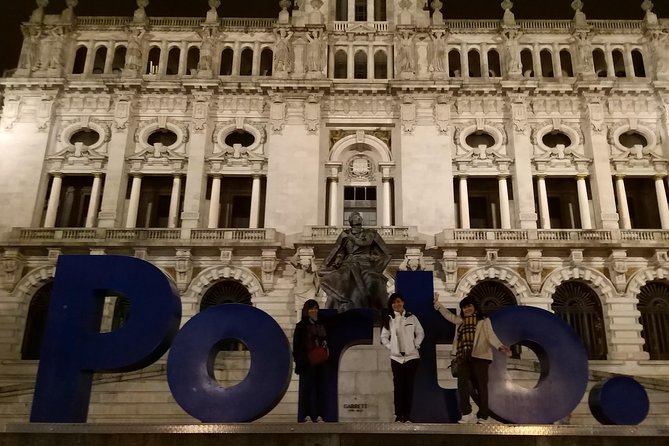
Porto at night has a different mood. The streets look sharper, the facades read better, and you can often photograph landmarks without the daytime crush. This tour leans into that. It’s private, which means you’re not stuck moving at the speed of a random group.
The route is also designed for flow. You start in central Porto and then hit a string of iconic stops that cover medieval pieces, major religious sites, classic architecture, and big Douro views. Even when a stop is short, it’s the kind of short that helps you connect the city’s story: square to cathedral, station to café culture, church to tower, then out toward the bridges and Gaia.
The experience is priced at $184.84 per person for about 3 hours. For a private night tour, that’s usually the sweet spot where you can justify the cost as “time saved plus comfort.” You’re buying guidance, vehicle comfort, and the ability to cover a lot without losing an entire evening to transit and searching.
A few other ways to explore Porto
- Porto: Bridges Cruise with Wine Cellar Tour or Sunset Option
★ 4.1 · 2,758 reviews - Porto: Douro River Party Boat with Sunset Option & 6 Bridges
★ 4.7 · 2,040 reviews - Porto: 6 Bridges Cruise & Port Wine with Sunset Option
★ 5.0 · 997 reviews
Comfort, Wi-Fi, and pickup: why the logistics matter on an evening tour
Night tours live or die by small details. Here, they take those details seriously. You get pickup from many downtown hotels and B&Bs in Porto and Gaia, with the default meeting point at Praça da Liberdade 19. That alone can remove a lot of stress, especially if it’s raining or you’re tired after dinner.
Once you’re in the vehicle, you’re not just riding. The tour includes Wi-Fi on board, bottled water, and refreshments. That matters more than you’d think when you’re switching between landmark viewing and quick photo moments. You can check where you are, confirm dinner plans, and upload pictures without burning battery.
You’re also covered with personal accident and liability insurance. That’s not the kind of thing you notice in the moment, but it’s part of why I’d feel comfortable booking an evening experience like this.
Finally, the tour has a mobile ticket and is offered in English. You won’t be guessing what you’re seeing. The guide gives you enough context to understand why each place matters.
Starting at Praça da Liberdade and D. Pedro Square: the center comes into focus
The tour begins in a very central hub area, Praça da Liberdade, which is a good launching point because it puts you close to the big walks and the classic avenues. From there, you’ll move toward the wide avenue feel around Avenida dos Aliados, with surrounding landmark buildings that date from the early 20th century era.
One highlight early in the route is D. Pedro Square, where you’ll see the statue of D. Pedro IV, the Liberator. In daylight, it can feel like a quick stop. At night, it reads as a symbol of Porto’s identity and power, especially with the nearby civic and historic buildings.
If you like your city nights to include clear “why is this here” explanations, this part works. You’re not just looking at big architecture, you’re getting the civic framing that helps you understand how Porto grew.
Mercado do Bolhão, Praça da Batalha, and the medieval spine of the city
Porto has a medieval core, but it’s easy to miss if you only wander casually. This tour targets that core fast.
You’ll stop at Mercado do Bolhão, one of the city’s most emblematic markets. It dates to 1850, with a two-floor neoclassical structure. The main market building is the star, but what I like is the surrounding street grid. The market opens toward multiple streets, and that helps you get the “how this neighborhood works” feeling without needing to shop.
Next, Praça da Batalha is the kind of square that feels small until the guide connects it to the city’s past. The name is tied to a battle around the 10th century, and the area became more urbanized around 1861, turning it into a major public space. The square also sits near Teatro São João, inaugurated in 1798 and later hit by a major fire on April 11-12, 1908.
Then you move to the Muralha Fernandina, a defensive wall that began in the 14th century under D. Afonso IV and only completed later, which is why it carries its specific name. It’s not about “full wall tours” here. It’s about understanding the line where the city’s expansion forced new defenses. At night, those surviving fragments give you a sense of direction, like the city’s older skeleton.
Another way to spend your time in Porto:
- The Unvanquished Tour in Porto City Center
★ 5.0 · 26,497 reviews - From Porto: Douro Valley w/ Boat Tour, Wine Tasting & Lunch
★ 4.7 · 19,061 reviews - Complete Douro Valley Wine Tour with Lunch, Wine Tastings and River Cruise
★ 5.0 · 12,920 reviews - Porto: Live Fado Show with Glass of Port Wine
★ 4.8 · 6,498 reviews
Catedral do Porto and São Bento Station: the stop that often steals the show
If you want one moment that’s both iconic and easy to love, this section is it.
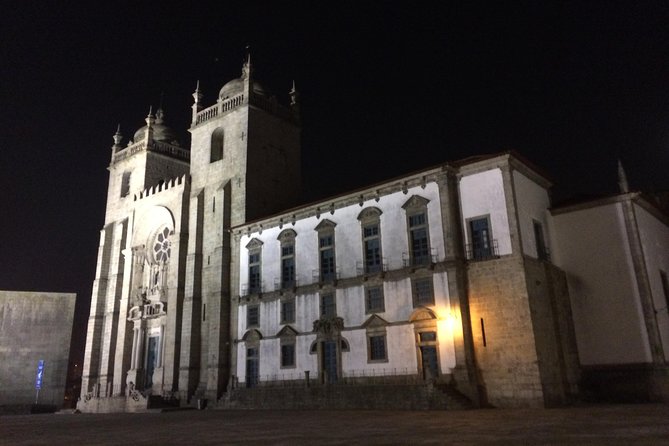
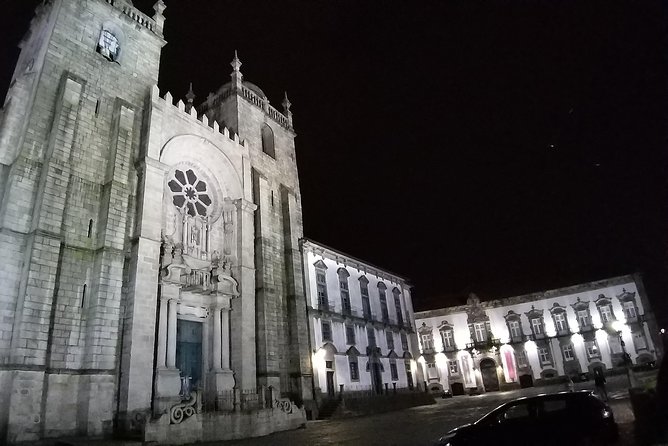
You’ll visit Catedral do Porto, dating to the 12th or 13th centuries, expanded and renovated over time. The guide points out key features such as the Gothic Chapel of St. John the Evangelist and the cloister, plus areas like the Blessed Sacrament chapel with its silver altar. Admission isn’t included, so you should plan for tickets if you want to go in fully.
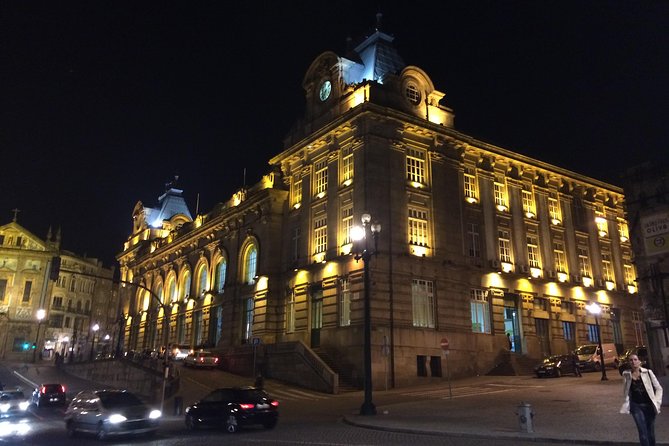
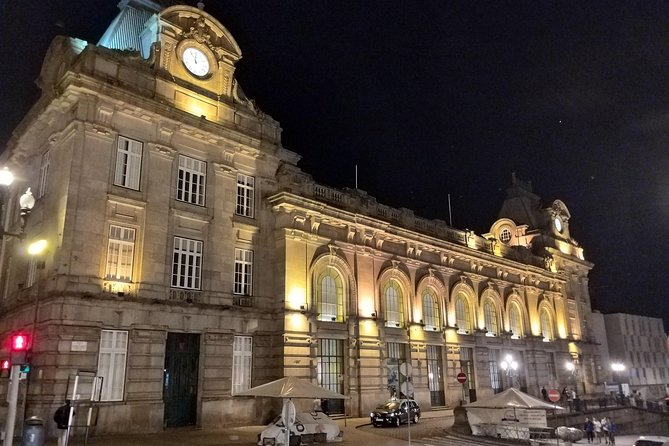
Right after, São Bento Railway Station is where Porto turns cinematic. The station was built in the early 20th century on the site of a former convent. Inside, the vestibule is decorated with 20,000 painted tiles by Jorge Colaço, telling stories of transport, Portuguese history, and local daily life. The ticket cost is listed as free, so this is one of the easiest “yes, do this” stops for value.
In a night tour, stations like this work well because you can slow down for a moment without committing to a long museum schedule.
Café Majestic, Rivoli Theatre, and the elegant street rhythm of Porto
Porto’s night vibe isn’t only churches and bridges. It’s also cafés, clocks, and places where people gathered before modern life took over.
You’ll pass Café Majestic, opened in 1921 with an Art Nouveau interior. The interior details are the point here, marble, gilded mirrors, and intricate woodwork. You can treat this stop like a quick taste of Belle Époque Porto, even if you don’t sit long.
Nearby is a fun timed detail, the Relógio das Galerias Palladium. It’s an ornate clock with a carillon and statues that perform every three hours. That’s the kind of thing you might miss if you’re rushing, so it helps that the tour builds in this area.
From there, you’ll also see Rivoli Theatre, a venue that went through major changes over the years. It was adapted to cinema while also hosting performances, and it later closed for a big remodeling completed in 1997. Even if you do not go inside, the theatre area gives you a sense of Porto’s arts infrastructure.
You’ll also have a stop tied to the University of Porto’s historic presence, a neoclassical building designed by Carlos Amarante, financed in 1803 through a tax on wine (the literary grant). Today it connects to the rectory and museums focused on science and natural history.
Igreja do Carmo, Igreja das Carmelitas, and Casa Escondida
Religious buildings in Porto can feel like separate worlds, but the tour smartly links them.
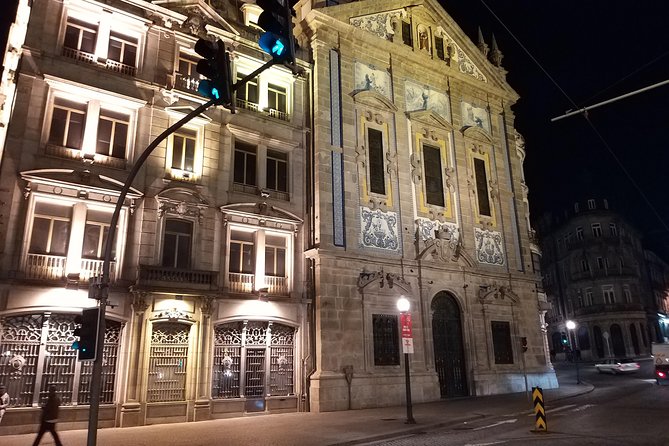
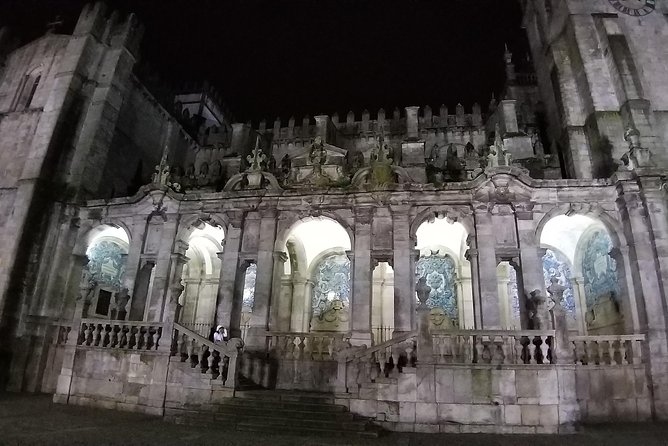
You’ll see Igreja do Carmo and Igreja das Carmelitas, both Baroque and both known for impressive details. The exterior of Igreja do Carmo features azulejos (painted ceramic tiles), which often pop at night under street lighting.
Then comes the part I’d call the “wait, what is that?” stop: Casa Escondida, a small hidden house wedged between the two churches. It’s exactly the kind of urban puzzle you don’t notice if you’re just walking fast. The payoff is that you start seeing the city’s density as a design challenge, not just a drawback.
This is also a good reset after heavier architecture stops. It’s quiet, small-scale, and slightly mysterious.
Clérigos Tower and Livraria Lello: views and design for people who care about details
No Porto highlights night is complete without Torre dos Clérigos. It’s a Baroque tower by Nicolau Nasoni, built in the first half of the 18th century. The key practical detail is that the climb involves 240 steps, and admission is not included.
Is it worth it? For many people, yes, because the tower offers panoramic views over Porto and the Douro River. And it’s also a fun modern trivia point, it appeared in the 2021 Hollywood blockbuster Suicide Squad.
After that, you’ll reach Livraria Lello. The building opened in 1906 and has an Art Nouveau façade with Neo-Gothic details. Inside, you’ll see painted plaster that mimics wood, plus a dramatic staircase that connects floors. The tour lists admission as not included, so treat it as a “buy ahead in your head” stop if you want interior time. The stained-glass skylight is also specifically noted, with a monogram and motto.
This pair of stops works because you get two different pleasures: one is about height and city panorama, the other is about design and craft.
National Public Library, Electric Car Museum, and transport history in motion
Porto isn’t only about medieval stone. It also has a strong story in culture and transport.
You’ll visit the National Public Library, described as Portugal’s oldest public library. It began in a convent setting and then moved to the Palace of the Carrancas, where it has operated as a museum of fine arts, decorative arts, and archaeology since the mid-20th-century era.
Next, you’ll reach the Electric Car Museum in a former municipal building. It holds trams and auxiliary vehicles once used on Porto streets, and it even includes an example of an American horse-drawn trolley bus, introduced in 1872. If you like industrial design or transportation history, this is a memorable curveball that still fits the Porto story.
The tour also stops at a 19th-century neoclassical building connected to the Museum of Transport and Communications, which opened in 1992. The building’s architecture is described as a mix of iron with other materials like stone, brick, and wood depending on space needs. That kind of detail is exactly why guided nights are valuable.
Igreja de São Francisco and Palacio da Bolsa: big artistry where you can feel the scale
Two of the most important religious and civic landmarks of Porto sit together in feel, if not in distance.
Igreja de São Francisco is described as Porto’s most important Gothic temple, with construction begun in the 14th century and later transformation in Baroque style. The interior is famous for its golden woodwork, and the guide points you toward highlights like the Tree of Jesse and visiting the catacombs. Admission is not included.
Then you’ll see Palácio da Bolsa, a National Monument built in 1842 in a neoclassical style, associated with Porto’s Commercial Association. It’s known for the Arab Room as its main highlight, and admission is not included. Even from a viewpoint outside, this stop signals Porto’s role as a trading and wealth engine.
If you like tours that connect religion, commerce, and art into one evening story arc, this is a strong section.
Douro bridges at night: suspension bridge remains, São João, Maria Pia, and D. Luís I views
The heart of the Porto night experience is crossing into the river’s visual territory. Your stops focus on bridges and viewpoints, which make the night route feel like it has momentum.
You’ll see what’s left of the early suspension bridge that once connected Porto and Gaia. It was created by a French company and inaugurated in 1843, but it was deactivated after about four years due to insecurity concerns. Now, only two stone pillars remain.
Then the tour spotlights Ponte D. Maria Pia, Gustave Eiffel’s first masterpiece, inaugurated in Porto in 1877. It replaced the earlier suspension bridge and operated for 114 years until the São João Bridge took over. Admission is free.
After that, you’ll move to the São João Bridge context, which connects Campanhã station to destinations in the south. The described design uses a gantry solution and majestic pillars founded near the riverbanks. That stop is free as well.
Another bridge in the route is D. Luís I Bridge, where a deck designed for Porto Metro lines is mentioned. The description includes measurements and the claim it set a record in its arch typology. Admission is listed as free.
There’s also time for more modern bridge energy with the Arrábida Bridge, inaugurated in 1963 and once noted for being the longest reinforced concrete bridge in the world. The stop description includes 70 meters above average water level and mentions bronze sculptures on top of the pillars.
At night, bridges are where your “I get it now” feeling often kicks in. You’re not just seeing buildings. You’re seeing how Porto and Gaia connect, and why so much effort went into these river crossings.
Jardim do Morro, Serra do Pilar, and forts in Gaia: viewpoints plus a sense of defense
Once you’re in Gaia territory, the tour shifts from “city icons” to “why this place matters for control and view.”
You’ll stop at Jardim do Morro, a public hill garden with panoramic views and a calm atmosphere. The tour notes it was developed in the 20th century and complements a monastery setting nearby.
Then you’ll reach Mosteiro da Serra do Pilar, a monastery on a hill by the Douro. Construction began in 1538 and the design changed over centuries, creating a circular church and cloister. It’s a National Monument and part of the UNESCO listing with Porto and the Luís I Bridge.
From there, you’ll see the military side with Fortress São João Baptista and Castelo do Queijo. The first is a coastal protection fort from the late 16th century with later additions. The second is described as Fort São Francisco Xavier, built in the 17th century to protect from pirates, and named for its hill shape like cheese. Both have admission listed as not included.
Modern Porto in one night: Anemone, Leixões, Serralves, and Casa da Música
Not every great night tour stays in the past. This one also points at modern Porto.
You’ll see She Changes, also known as Anemone, a sculpture by Janet Echelman made from a moving fishing net inspired by wind and sea currents. It’s meant as public art for Porto and Matosinhos.
Then there’s Leixões Port, tied to cruise growth since the opening of a new cruise pier in April 2011. The description includes passenger and ship growth numbers, so the stop feels grounded in real port development rather than just sightseeing.
You’ll also get Serralves territory, with Serralves Park and the Art Deco House (the Casa da Musica area is separate, but Serralves is the art complex here). The park is described as stretching over 18 hectares, with gardens, a traditional farm, and even a forest. The house is described as one of Europe’s best examples of Art Deco movement, built in the 1930s, used for exhibitions and events.
Then comes Casa da Música, Porto’s main concert hall in the Boavista area, designed by Rem Koolhaas and inaugurated in 2005. The tour lists free admission for the stop.
Monuments near Praça de Mouzinho de Albuquerque: when night lighting turns sculpture into drama
To finish strong, you’ll see the Monument to the Heroes of the Peninsular War at Praça de Mouzinho de Albuquerque. The monument is anchored by a tall central piece, described as 45 meters high, and it includes groups of sculptures representing the union of Portuguese with the English (the lion) and victory against French Napoleonic armies (the eagle). Admission is listed as free.
Even if you never read a plaque, it’s the kind of sculpture that looks better at night. The scale holds attention, and the lighting gives surfaces definition.
Optional extras: fado with Port wine and a Dona Antónia Port tasting
If you want this night tour to become a full cultural evening, the optional add-ons can make sense.
Fado show with Port wine
The optional fado experience runs daily at 18:00 and 19:30 for 1 hour. It includes Port wine tasting and is described as an authentic fado night focused on Portuguese music, plus daily scheduling details. Pricing for this add-on is listed as €20.00 to €26.00. It is not included in the base tour price, and it starts 2 hours earlier than the main tour timing.
Exclusive Dona Antónia Port wine cellars tour
The Dona Antónia add-on is €32.00 to €41.00 and lasts 1 hour 30 minutes. It includes tasting of 5 Port wines. The description ties it to Dona Antónia Adelaide Ferreira and culminates in a tasting of wines named after her. Like fado, it is not included, and it starts 2 hours earlier than the main tour timing.
These add-ons fit best if you already know you want music or wine as a theme for your Porto night. If you do not, you might be better off keeping the night light and ending with a relaxed meal after the tour.
Price and fit: who this private night tour is best for at $184.84 per person
At $184.84 per person, you’re paying for three main things: private pacing, guided context, and comfort. The vehicle includes Wi-Fi, bottled water, and refreshments, plus coverage via insurance. Those details are not flashy, but they make the difference between an evening that feels like a chore and one that feels smooth.
This is especially good for you if:
- you want iconic Porto sights fast, with explanation
- you dislike long nighttime walks and prefer vehicle hopping between areas
- you want a guide who can help you understand what you’re seeing, not just where to stand
- you’re visiting for the first time and need a mental map of Porto before bigger day tours
It can feel less ideal if you only want one or two major attractions and plan to skip any interior visits, since the tour is built around moving through many highlights. The good news is that it’s short per stop, so you can still pick what matters most to you during each brief moment.
One more practical note: it’s a good weather experience. If weather turns, the tour provider says you’ll get a different date or a full refund.
Should you book this Porto private night tour?
Yes, if your goal is to see Porto’s biggest landmarks in a single organized evening, with private guidance and real comfort. The guide quality is a standout, with strong praise for Carlos’s punctuality, his ability to pack in lots of context, and his ability to keep things fun even when rain pops up.
I would book it if you also want a sense of Porto that goes beyond photos, with stops tied to history, architecture, and the river crossings that shape everyday life here. And if you’re tempted by the optional fado or Port tasting, it’s a good match because this tour is essentially the “city overview” piece of your night.
If you hate ticket uncertainty, go in knowing that some places are listed as not included and you may choose to buy those as you go. With that plan in mind, this tour is a strong value for an evening that actually feels worth paying for.
FAQ
How long is the Porto private night tour?
It lasts about 3 hours.
What is the price per person?
The price is $184.84 per person.
Is the tour private?
Yes. Only your group participates.
What pickup options are available?
Pickup is offered to hotels and B&Bs in downtown areas of Porto and Gaia. If you are not picked up, the meeting point is Praça da Liberdade 19, 4000-322 Porto.
Is onboard Wi-Fi included?
Yes. The vehicles include Wi-Fi.
What language is the tour offered in?
The tour is offered in English.
Are attraction tickets included for every stop?
No. Some stops list admission as free, while several notable sites list admission as not included.
What optional add-ons are available?
Optional add-ons include a fado show with Port wine (priced €20.00 to €26.00, 1 hour) and an exclusive Dona Antónia Port wine cellars tour (priced €32.00 to €41.00, 1 hour 30 minutes with tasting of 5 Port wines).
When do the fado show sessions run?
The fado show runs daily at 18:00 and 19:30.
What happens if the weather is poor?
The experience requires good weather. If it’s canceled due to poor weather, you’ll be offered a different date or a full refund.
Recently reviewed around Porto
- BRAGA E GUIMARÃES Private Historic Tour from Porto★ 5.0 · 7 reviews
- Douro Valley in off road – Private Tour★ 5.0 · 3 reviews
- Porto: Private Tour on a Luxury Yacht on the Douro River★ 5.0 · 9 reviews
- Porto Private Walking Food Tour With Secret Food Tours★ 5.0 · 31 reviews
- Porto Private Custom Tour with a Local: Highlights & Hidden Gems★ 5.0 · 51 reviews
- Santiago de Compostela and Cathedral Private Tour From Porto★ 4.5 · 6 reviews
- Private Tour: Porto to Lisbon: visit Aveiro,Coimbra,Fatima,Obidos★ 5.0 · 5 reviews
- Porto, Private Tour in the Douro and Sea or Sunset★ 5.0 · 24 reviews
Evening Experiences, compared.
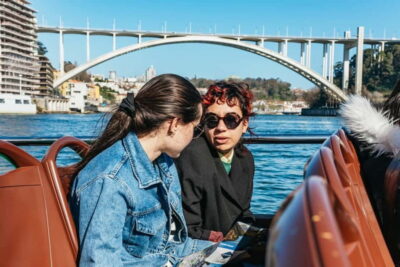
Bridges Cruise with Wine Cellar Tour or Sunset Option
Read our review →
Douro River Party Boat with Sunset Option & 6 Bridges
Read our review →
Charming Sailboat Cruise with Port Wine,Sunset Option
Read our review →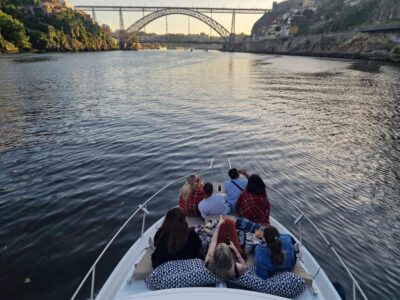
6 Bridges Cruise & Port Wine with Sunset Option
Read our review →
Porto Douro River Cruise With Port Wine – Daytime or Sunset
Read our review →
Daytime or Sunset Douro River Sightseeing Cruise
Read our review →
Port : 6 Bridges Cruise , Douro River with Sunset Option
Read our review →Browse the lists this tour appears in