
Reviewed · TUK TUK TOURS
Porto Half Day Private Tuk Tuk Tour
Porto is a city of steep hills, tiled facades, and sudden viewpoints around every corner. This private half-day tuk-tuk tour is interesting because it trades walking fatigue for short rides, then gives you expert context at the stops so the city makes sense fast. I like that the experience is guided end-to-end, not just a drive around town, and I also like how the route can be adjusted to your interests. A possible drawback to keep in mind: traffic and a lot of quick photo moments can make the 3 hours 30 minutes feel tight, so plan to move efficiently.
What really wins for me is the way the route balances classic highlights with panoramic payoffs. You get to see the Dom Luis I Bridge area plus the riverfront views from above, which is hard to replicate solo without a lot of stairs and backtracking. And because it is private, you can ask your guide to linger where you care most, like architecture, viewpoints, or quieter garden breaks.
Quick Takeaways Before You Roll in a Tuk-Tuk
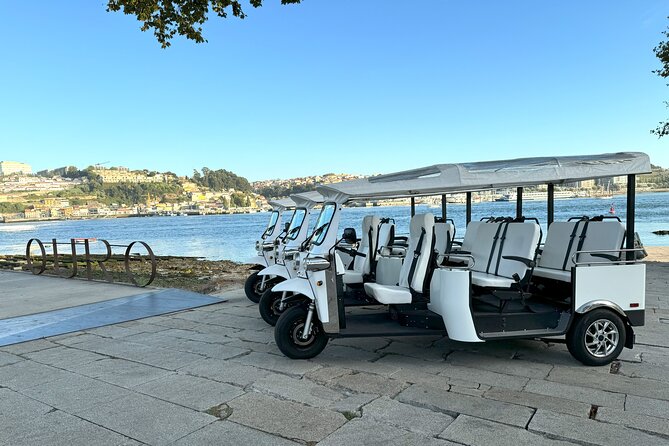
- Private tuk-tuk, not a bus ride, with a driver/guide and live commentary along the way
- City orientation in about 3.5 hours, built for first-timers who want a big-picture understanding
- Serra do Pilar terrace views give you Porto and Gaia at a glance, without long hikes
- Iconic interiors are on the route, including a church famous for gilded wood and catacombs
- A wine tasting is included, which helps make the tour feel more than sightseeing
- Weather matters, and the tuk-tuk canopy can affect sight lines in rain or cloud cover
Why Porto Works So Well With a Tuk-Tuk
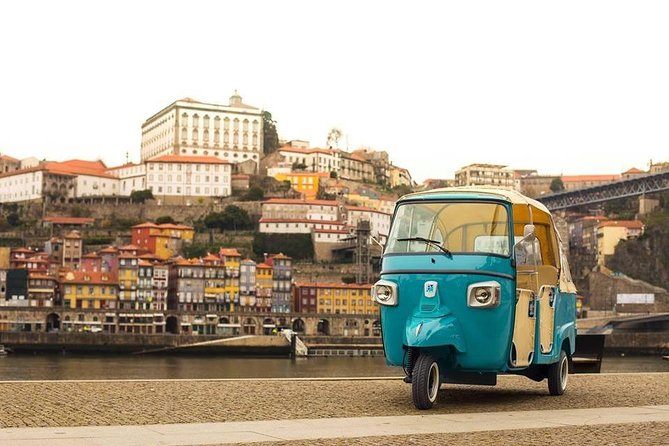
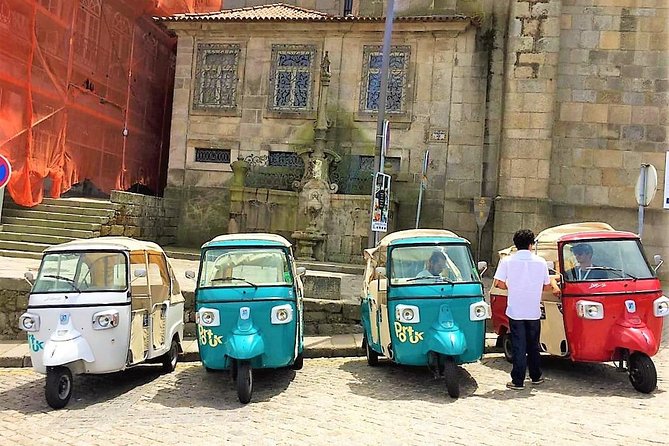
Porto’s topography is the main reason this style of tour works. Streets zig and zag up and down, and many of the most rewarding areas sit just far enough from each other that a walking-only day can feel like punishment. A tuk-tuk lets you cover ground while your guide keeps the story moving, so you spend your energy looking and learning instead of negotiating steep steps.
The other practical benefit is access. Tuk-tuks can slip through tight streets where cars and bigger vehicles struggle. That matters in central Porto, where bottlenecks and construction zones can slow everything down. When you are on a fixed time window, fewer delays usually means more actual viewing time.
One more small but real point: you do not need to be an architecture expert to enjoy this route. Your guide can steer you toward what to notice, like design details on facades, why a building was placed where it is, and how Porto’s neighborhoods connect to the river and trade routes.
More tuk tuk rides through Porto:
- Porto: Guided Tour by Tuk-Tuk & Optional Douro River Cruise
★ 4.5 · 5,980 reviews - Discover Porto’s Highlights on a 2-Hour Private Electric Tuk Tuk
★ 4.5 · 1,860 reviews - Historic Porto by Private Electric Tuk Tuk to Top Landmarks
★ 4.5 · 735 reviews
Price and Value: What $83.48 Really Buys You
At $83.48 per person for a private tour lasting about 3 hours 30 minutes, you are paying for three things at once: a tuk-tuk vehicle for your group, a licensed driver/guide, and guided time at multiple major sites. For me, that is the value math. If you tried to stitch together a similar mix of viewpoints, bridges, gardens, and interior stops on your own, you would spend more time on transit and less time learning what you are looking at.
Also, this is not only a drive. Wine tasting is included, which turns the tour into an experience rather than a list of stops. Even if the tasting is short, it gives you a Porto flavor moment that feels connected to the city’s identity.
Is it expensive compared to a cheaper tuk-tuk tour? Often, yes. But private time in Porto is where the money goes, because you avoid delays from other groups and you can ask questions in real time.
The “3.5 Hour” Route Logic, From Ruins to River Views
This tour is built like a loop: it strings together major historical landmarks, then adds viewpoint pressure relief (terraces and gardens), and ends in central sights. The best way to use your time is to think in pairs. For example, you should treat Porto and Gaia as a matched set because of how the river frames the city. Then, treat viewpoints as your breaks between heavier history stops.
Here’s what to expect in pacing. You will have a mix of quick look-and-learn moments, photo stops where you can step out, and a few sites where the stop is short. If you are the type who likes slow museum-style reading, you might feel you are moving quickly. But if your goal is to get your bearings and pick your return targets later, this schedule is right on target.
If rain shows up, plan for a practical issue: the tuk-tuk canopy can limit your view for photos. Ask your guide to pause for a clean shot when something opens up visually, especially near viewpoints and bridges.
Start Point to Porto’s Theatrical Heart: São João Area and Old City Layers
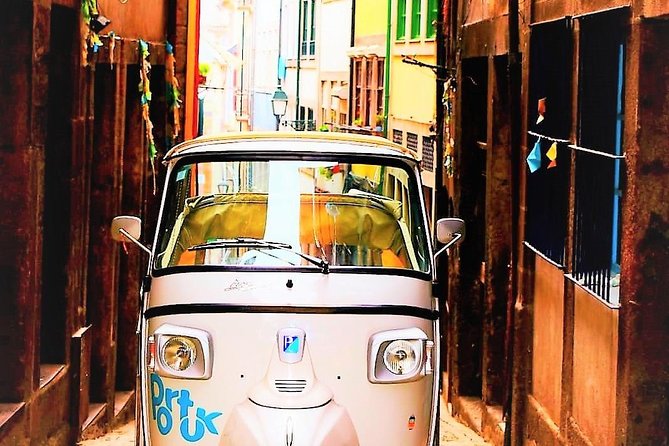
You meet at R. de Augusto Rosa 180, 4000-528 Porto, and from there the tour quickly aims for central, story-rich spots. One early stop centers on a major theater complex with a strong timeline. The building you see was constructed in 1910 on top of ruins from the Real Theatre, which burned down in 1908. Even the facade tells you something: it draws on Luís XVI style cues from early twentieth-century renovations, and the design is credited to Marques da Silva.
What I like about starting here is that it immediately shows Porto’s layering. This is not a city where history is one page. It is stacked. A modern-looking facade can sit on top of earlier tragedy, then connect to nearby cultural institutions, including the National Theatre São João and its relationship to surrounding landmarks.
If you care about how cities reuse spaces over time, you will enjoy this stop. The tour does not linger long, but it gives you enough context to make the rest of the day click.
Another way to spend your time in Porto:
- The Unvanquished Tour in Porto City Center
★ 5.0 · 26,497 reviews - From Porto: Douro Valley w/ Boat Tour, Wine Tasting & Lunch
★ 4.7 · 19,061 reviews - Complete Douro Valley Wine Tour with Lunch, Wine Tastings and River Cruise
★ 5.0 · 12,920 reviews - Porto: Live Fado Show with Glass of Port Wine
★ 4.8 · 6,498 reviews
The 12th-Century Romanesque Wall: Porto as a City With Boundaries
Next comes a Romanesque wall segment dating to the 12th century, built to mark Porto’s administrative and urbanistic extent during a time when population had been more dispersed. Even if you only catch a portion of the structure, it is a powerful reminder that cities were once defined by walls and controlled access.
This is the kind of stop that can be either memorable or forgettable, depending on your mood. If you like the idea of seeing where a city ended and began, you get a mental map. If you want only big skyline views, you might feel this one is too brief. Either way, it helps explain why Porto’s center feels like a maze, because it grew inside constraints.
Serra do Pilar Monastery: The Terrace View That Makes Time Feel Worth It
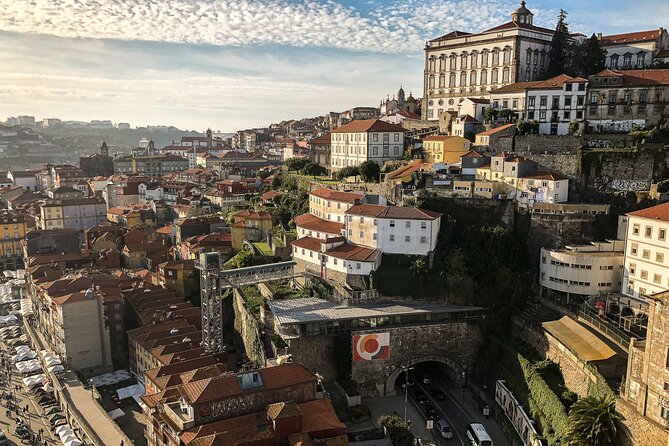
Serra do Pilar is one of the highest value stops on the route. The monastery complex is a World Cultural Heritage site, with construction beginning in 1538 and finishing around 1670. It started as a home for Augustinian Friars of the Monastery of Grijó, then later played a role during the Civil War of 1832 to 1834 when the liberal army settled there. The building fell into disrepair after constant attacks, then was restored, first with the Royal Brotherhood of Lady of the Pilar, and later through recovery groups.
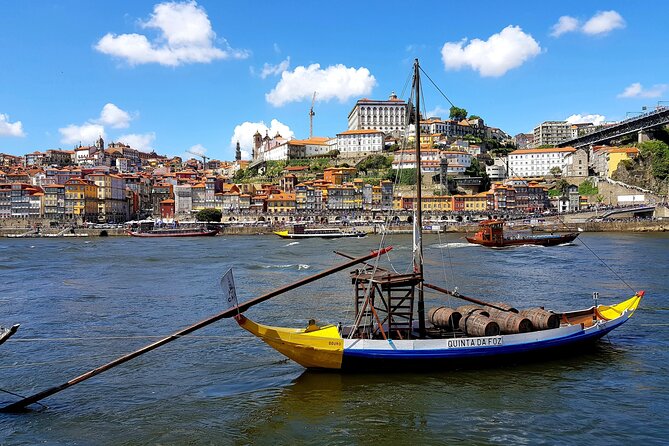
What you really come for is the church design and the terrace. The church has a circular plan and the dome is ringed by a balcony. The cloister is also circular with 36 Ionic columns, and the terrace gives you sweeping views across the riverside toward Gaia, the historic center, and key landmarks like the Cathedral and Dom Luis I bridge. On a clear day, you can even pick out areas like Fontainhas and the São João bridge from the opposite direction.
This stop is short on paper, but it pays you back visually. If you only remember one viewpoint from Porto, make it this one.
Dom Luis I Bridge: Engineered Elegance and the Metro Line Above You
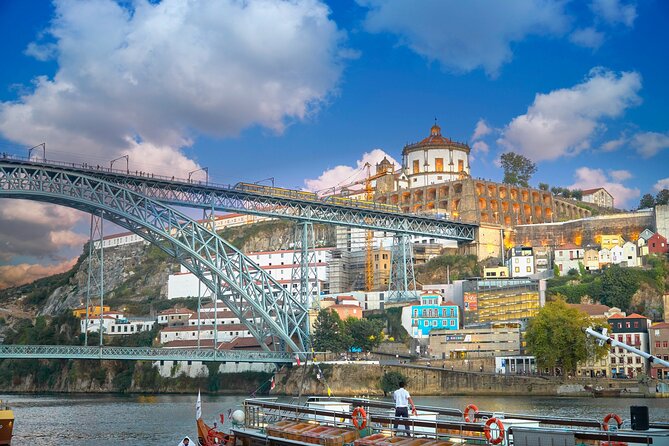
From Serra do Pilar, the tour naturally connects to the famous iron architecture of Dom Luis I Bridge. The bridge was planned by engineer Teófilo Seyrig, a disciple of Eiffel, and inaugurated in 1886. It has two overlapping iron decks, spans 395 meters long and 8 meters wide, and still gets credit as a world-leading forged iron arch.
The practical detail that makes this bridge feel alive today is how it functions. The upper deck is used by the Metro of Porto, connecting the area of Porto’s Cathedral to the Garden of Morro and onward toward Avenida da República in Vila Nova de Gaia. That means as you ride and look, you are not just seeing a monument. You are seeing part of the city’s transportation system.
If you love infrastructure that becomes identity, this is your stop. Even in a quick look, you can see why this bridge became an icon.
The Church of Gold and Its Catacombs: Porto Inside, Not Just Outside
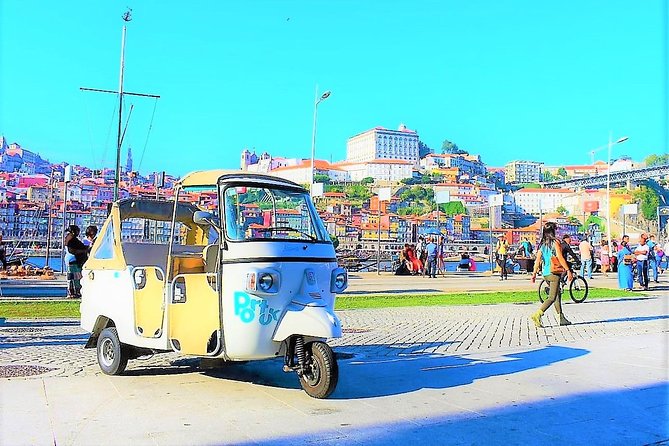
One of the most celebrated stops on this route is a Gothic temple whose construction began in the fourteenth century. The interior is known for exuberant gilded woodwork, and it has a reputation that has been described in vivid terms, including a reference to the Church of Gold. Construction details you will hear about include the Tree of Jesse and the presence of catacombs.
It is also a National Monument since 1910, and part of UNESCO World Cultural Heritage since 1996. That tells you something important: this is not just decorative. It is a protected cultural site that carries religious and artistic weight.
A short caution: this stop can feel like a whirlwind if you try to absorb everything at once. Instead, pick two things you want to notice, like the gilded carving work and then the catacombs area. Then let the rest be atmosphere.
If you want the best return on your time, use the guide’s pointing out to decide what is most distinctive, then come back later if you fall in love with it.
Palácio da Bolsa and the Arabian Room Focus: Business Heritage With Theatre-Grade Style
Another standout stop is Palácio da Bolsa, the Stock Exchange Palace and headquarters of the Commercial Association of Porto. Designed in 1842 in neoclassical style by Joaquim da Costa Lima, it sits in the historical center and is among the most visited monuments, with the famous Arabian Room called out as the major highlight.
I love this kind of stop because it breaks the usual tourism pattern. Many Porto highlights are religious or scenic, but this one shows how wealth and trade shaped the city. You get a sense of how Porto’s prosperity wanted its own stage.
One practical note: the tour indicates admission is not included for this site. That matters if you are budgeting time and entry. If you want interiors inside, you may need a separate plan or a follow-up visit.
Mercado Ferreira Borges, Alfândega Nova, and Hard Club Energy
The route also hits the kind of architecture you might walk past without noticing. There is a market built in 1885 by city order to replace the old Mercado da Ribeira. It represents iron architecture in Porto, and after renovations it became an entertainment venue, where Hard Club is located.
Then, you see a neoclassical building related to transport and communications, designed by engineer Jean F. G. Colson. It has two facades, one facing the Douro river and one facing the city, and the structural logic uses iron along with other materials based on function. In 1987 it became the home for the future Museum of Transport and Communications, with restoration and adaptation credited to architect Eduardo Souto Moura.
Even if museums are not your thing, this section is useful because it explains Porto’s economic backbone. You start seeing the city’s infrastructure as part of the story, not just the backdrop.
Gardens That Reset Your Legs: Palacio de Cristal and Cordoaria
Porto can be intense on the body, so these garden stops are smart. Jardins do Palacio de Cristal are one of Porto’s best-loved escapes, with sun-dappled paths, lawns, fountains, and sculptures. You will pass plantings like giant magnolias, camellias, cypress, and olive trees, plus built-in viewpoints over the city and the Douro.
This is not one garden. It is a mosaic of small gardens that unfolds as you wander, which is exactly what you want after a series of historical buildings.
Later, the tour reaches Cordoaria Garden, better known as Jardim de João Chagas. This garden is tied to rope makers who stayed in the area for about two centuries. The garden project was built in 1865 and 1866 by German landscaper Emile David. If you like art details, there are statues including Ramalho Ortigão and António Nobre, plus sculptures by Juan Muñoz from 2001, including O rapto de Ganímedes (Kidnapping of Ganímedes).
Garden stops also work as photo breaks. When you have greenery plus city views, your pictures look less like another street photo and more like a Porto memory.
Clérigos, Carmo Tiles, and the Lions Fountain Stop for Quick Icon Pics
As the tour swings back toward central sights, it includes a few quick hit icons. You will reach Torre dos Clérigos, a Baroque church bell tower that is visible from multiple parts of the city and is one of Porto’s recognizable symbols. The stop is short, so you mainly use it for exterior views and quick orientation.
Then there is Igreja do Carmo, a rococo building from the second half of the eighteenth century, known for interior carvings and a side facade covered with tiles in 1912. The tile designs were done by Silvestre Silvestri and connect to Our Lady imagery.
You also stop at Fonte dos Leões, the Fountain of the Lions, built in the nineteenth century by a French company and cast by a French foundry. The fountain is a copy in most part of one in Leicester, England. That makes it a fun “Porto has European connections” reminder, not just local design.
If you want a quick day of highlights without walking miles, these short stops are doing exactly what they should.
Antiga Cadeia da Relação: A Former Prison Now Used for Photography
One of the more thought-provoking stops is Antiga Cadeia da Relação, a granite building dating to 1582 and later rebuilt in 1767 in neoclassical style by Eugénio dos Santos. It has a geometric sequence of windows, 103 total. The building is polygonal with four facades, and its layouts reflect different functions, including areas tied to court use and a side entrance that used to allow direct passage of prisoners.
Two big names connected to the building are Camilo Castelo Branco and Zé do Telhado, both held there for offenses described in the tour info. After restoration between 1999 and 2002 led by Eduardo Souto de Moura and Humberto Vieira, the building became the Portuguese Centre for Photography, including an exhibition center.
This stop works because it adds human scale. It moves Porto’s story beyond monuments and into how people lived, punished, and later created.
Livraria Lello and the Art Nouveau Facade Moment
The tour’s final featured stop centers on Livraria Lello, inaugurated in 1906. Outside, the facade is Art Nouveau with neo-Gothic details. Inside, the library is decorated in painted plaster that imitates wood, with a striking staircase connecting floors, described as one of the early reinforced concrete works in Porto. There is also a large stained-glass skylight bearing the library’s monogram and motto, Decus in Labore.
This is a perfect closing stop because it feels like a prize. It is visual, stylish, and instantly Instagram-able in the best way, but the deeper value is that it shows Porto’s design ambition during the early twentieth century.
Admission is not included here, so treat it as a stop to see from outside unless you plan an extra ticket.
Wine Tasting: The Included Taste Moment to Anchor the Day
This tour includes wine tasting as part of the experience. The specific wines are not listed in the information provided, so I cannot promise a particular style. But practically, you should assume this is a short tasting stop that fits into the half-day pacing.
My advice: if wine matters to you, ask your guide what is being tasted and why it connects to Porto and the Douro region. A good guide turns wine from a sip into a story.
If wine is not your thing, you can still treat the tasting as a cultural punctuation mark. It helps keep the day from feeling like only architecture and streets.
Who This Tuk-Tuk Tour Fits Best
This is a strong fit if you want a first-day orientation and you are short on time. It is also ideal if you do not want to grind your legs up steep Porto streets for hours. If you love viewpoints, this route gives you terraces, bridges, and river views in a tight timeline.
It is also a good choice for mixed travel groups, like couples with different interests. The tour info notes that the itinerary can be adjusted for your preferences in a private setup, so you can aim for what matters most.
If you are a museum die-hard who wants long interior time, you might find the pace too fast. In that case, use this tour to create a hit list for later.
Should You Book This Porto Half-Day Private Tuk-Tuk Tour?
Book it if you want to see a lot fast, learn what you are looking at, and keep your day comfortable. The biggest practical reasons are the private tuk-tuk format, live commentary, and the fact that you get both Porto and Gaia perspectives, including a serious viewpoint moment at Serra do Pilar.
Skip or rethink it if you strongly prefer slow, detailed visits inside major sites, because this tour is designed for quick stops and efficient viewing within about 3 hours 30 minutes. Also, if weather is likely poor, remember the canopy can affect sight lines, so you may want a backup plan for extra time or photo stops.
If you do book, my best advice is simple: tell your guide what matters most at the start, and if traffic or pace starts to feel rushed, say so early. The private format only works when you speak up.
FAQ
How long is the Porto half-day private tuk-tuk tour?
It lasts about 3 hours 30 minutes.
What is the price per person?
The price is listed as $83.48 per person.
Is this tour private or shared?
This is a private tour, meaning only your group participates. For larger groups, multiple tuk-tuks may be used, but you keep the same stops at the same time.
What language is the tour offered in?
The tour is offered in English.
What is included in the tour price?
Included items are the driver/guide, live commentary on board, a local guide, and wine tasting.
Where do we meet for the tour?
The start meeting point is R. de Augusto Rosa 180, 4000-528 Porto, Portugal. The tour ends back at the meeting point.
Do I need tickets for the stops?
Some stops are listed as free, while others have admission not included. The Torre dos Clerigos, Igreja do Carmo, and Livraria Lello are listed as not included.
Is the tour ticket mobile?
Yes, it includes a mobile ticket.
Is the tour dependent on weather?
Yes. It requires good weather. If canceled due to poor weather, you are offered a different date or a full refund.
Are service animals allowed and can children join?
Service animals are allowed. Children must be accompanied by an adult, and most travelers can participate.
Recently reviewed around Porto
- Tour Porto: Adventure in Electric Bike Tour★ 4.3 · 11 reviews
- Porto: Tuk tuk Tours with Port Wine Tasting★ 4.5 · 65 reviews
- Tour Porto: Classic Adventure in Electric Tuk Tuk★ 4.7 · 33 reviews
- Tour Porto: Classic Car + A Toast with Port Wine★ 5.0 · 3 reviews
- The Beautiful Story of Porto: Guided Tour with Entry Tickets★ 4.8 · 111 reviews
- From Porto or Aveiro: 516 Arouca Suspended Bridge Tour★ 5.0 · 3 reviews
- Rent an Electric Bike with Bosch motor★ 4.5 · 3 reviews
- Self-Guided Bike to Surf”N”Food Pack★ 4.6 · 13 reviews
Tuk Tuk Tours, compared.
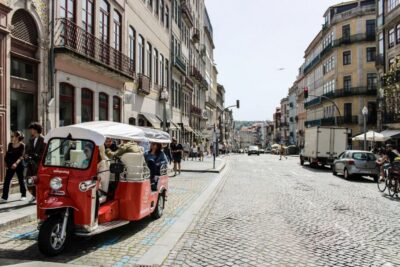
Guided Tour by Tuk-Tuk & Optional Douro River Cruise
Read our review →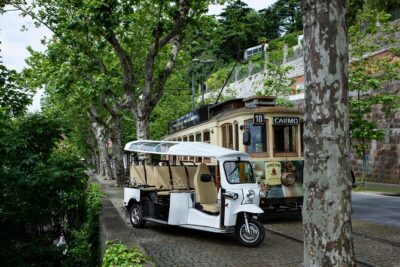
Discover Porto’s Highlights on a 2-Hour Private Electric Tuk Tuk
Read our review →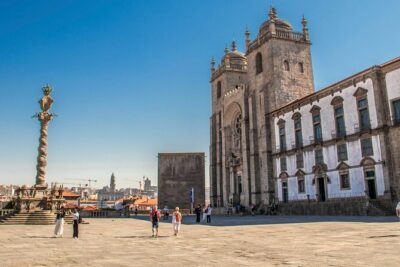
Historic Porto by Private Electric Tuk Tuk to Top Landmarks
Read our review →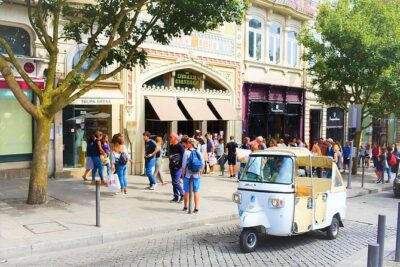
Porto Guided Tour to the Historical Center on a Tuk Tuk
Read our review →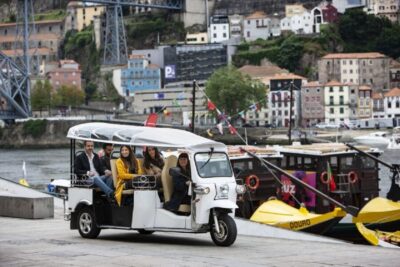
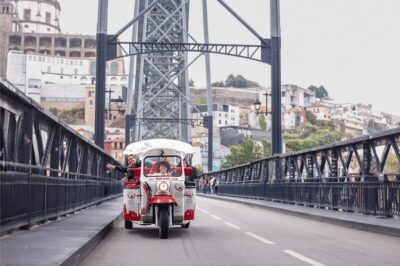
Oporto Tuk-Tuk Tour: Fast, Fun & Flexible – 1H to Full Day!
Read our review →
Porto Tuk Tuk: Clérigos, Seaside & Viewpoints – with Options
Read our review →
Browse the lists this tour appears in